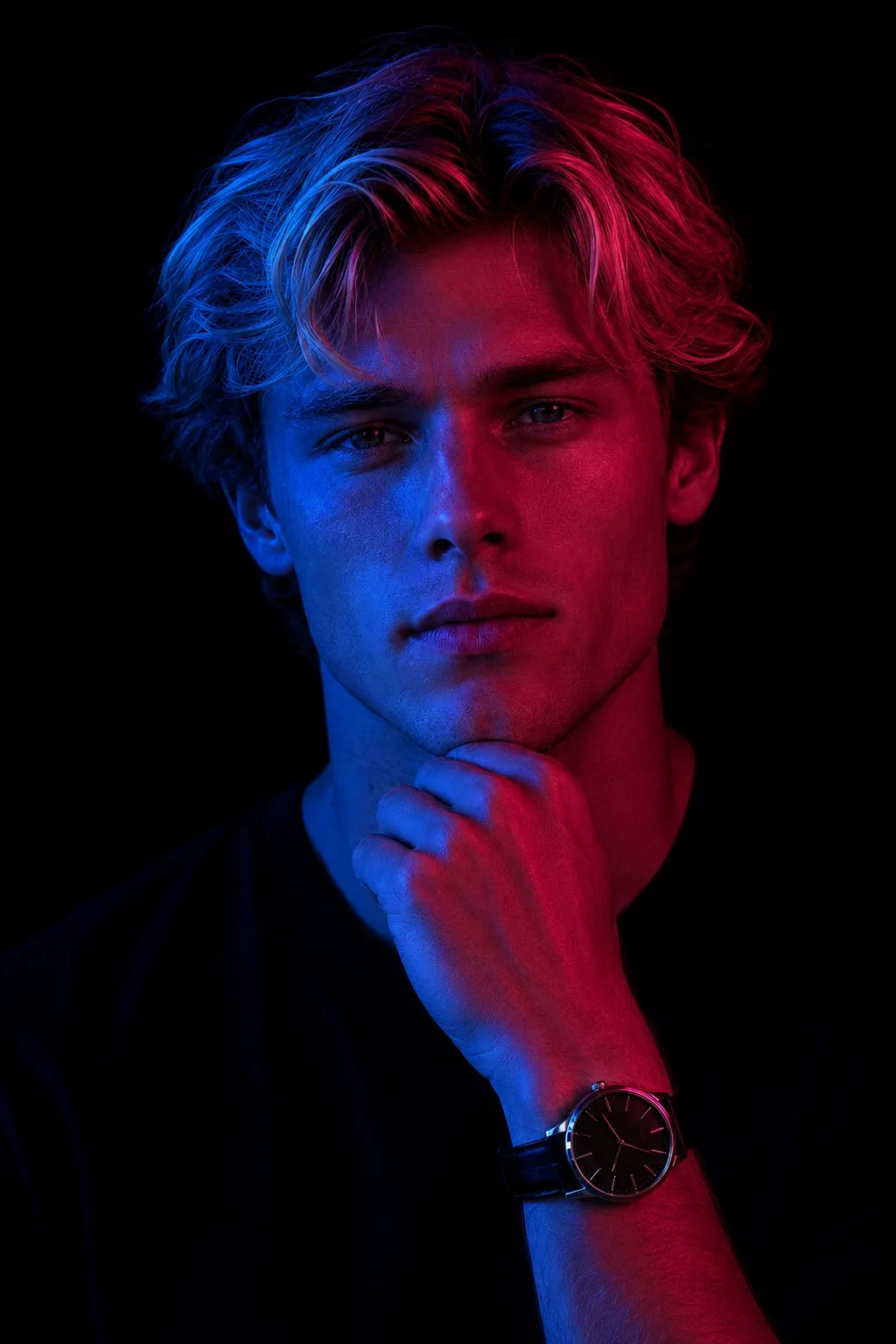
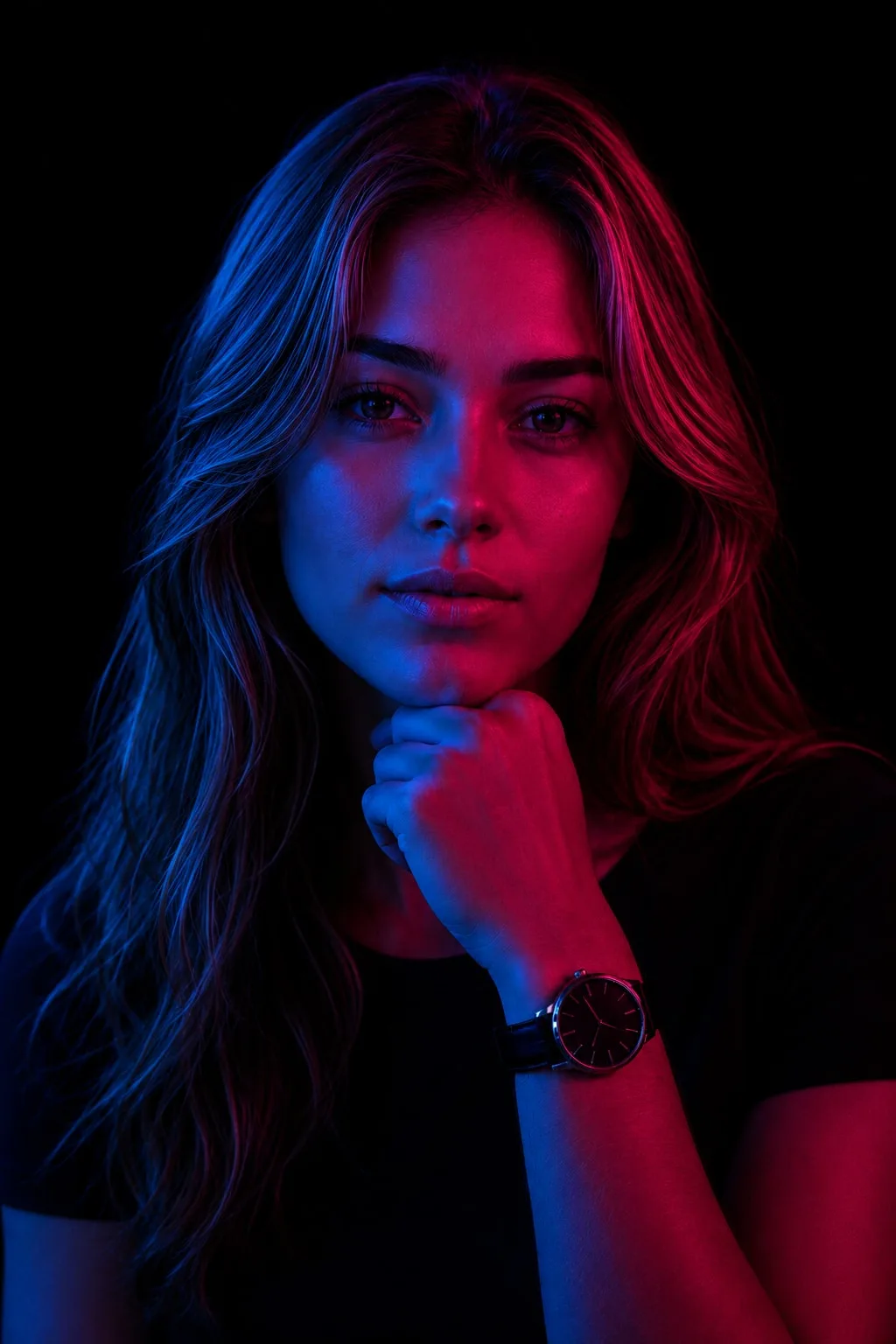
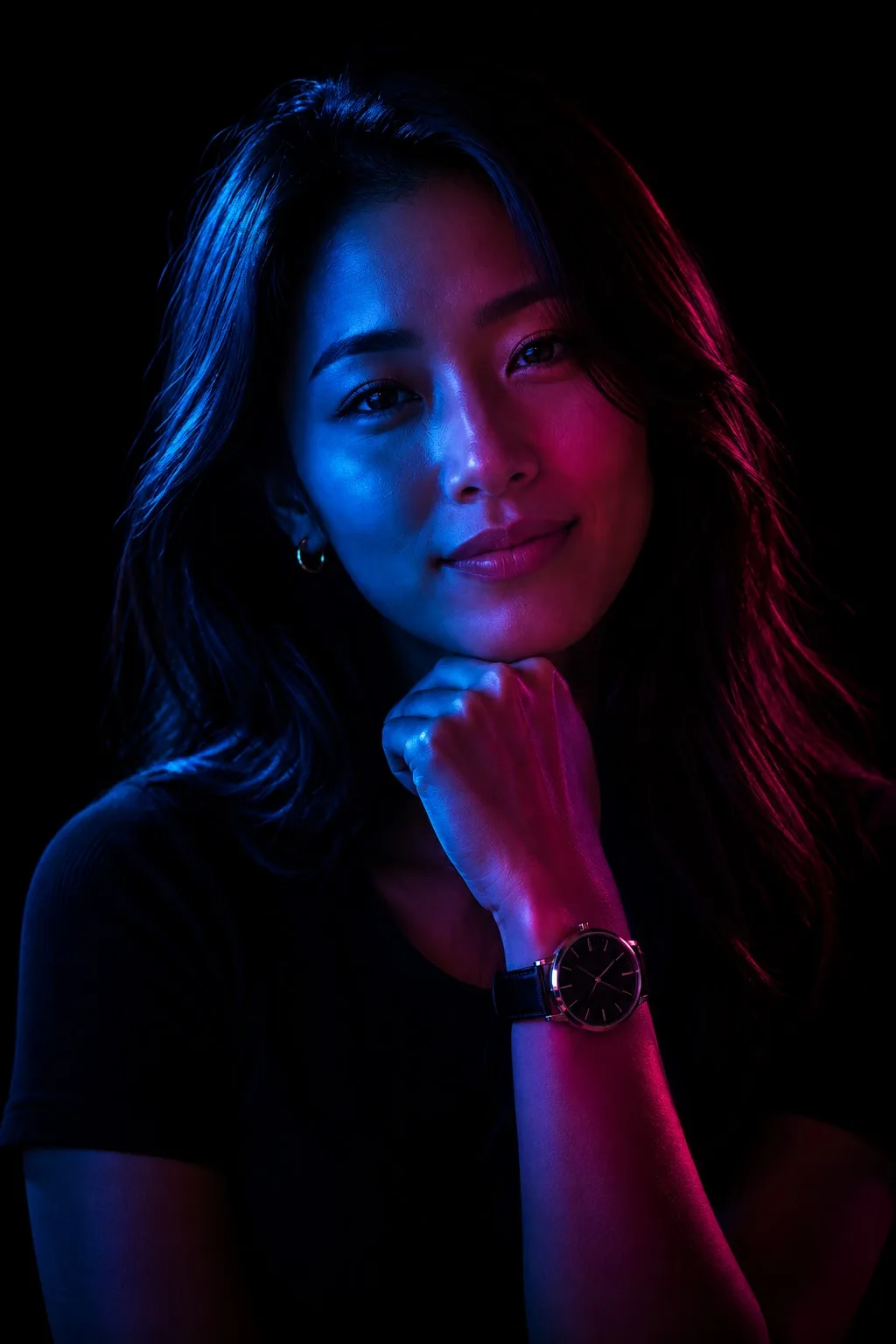
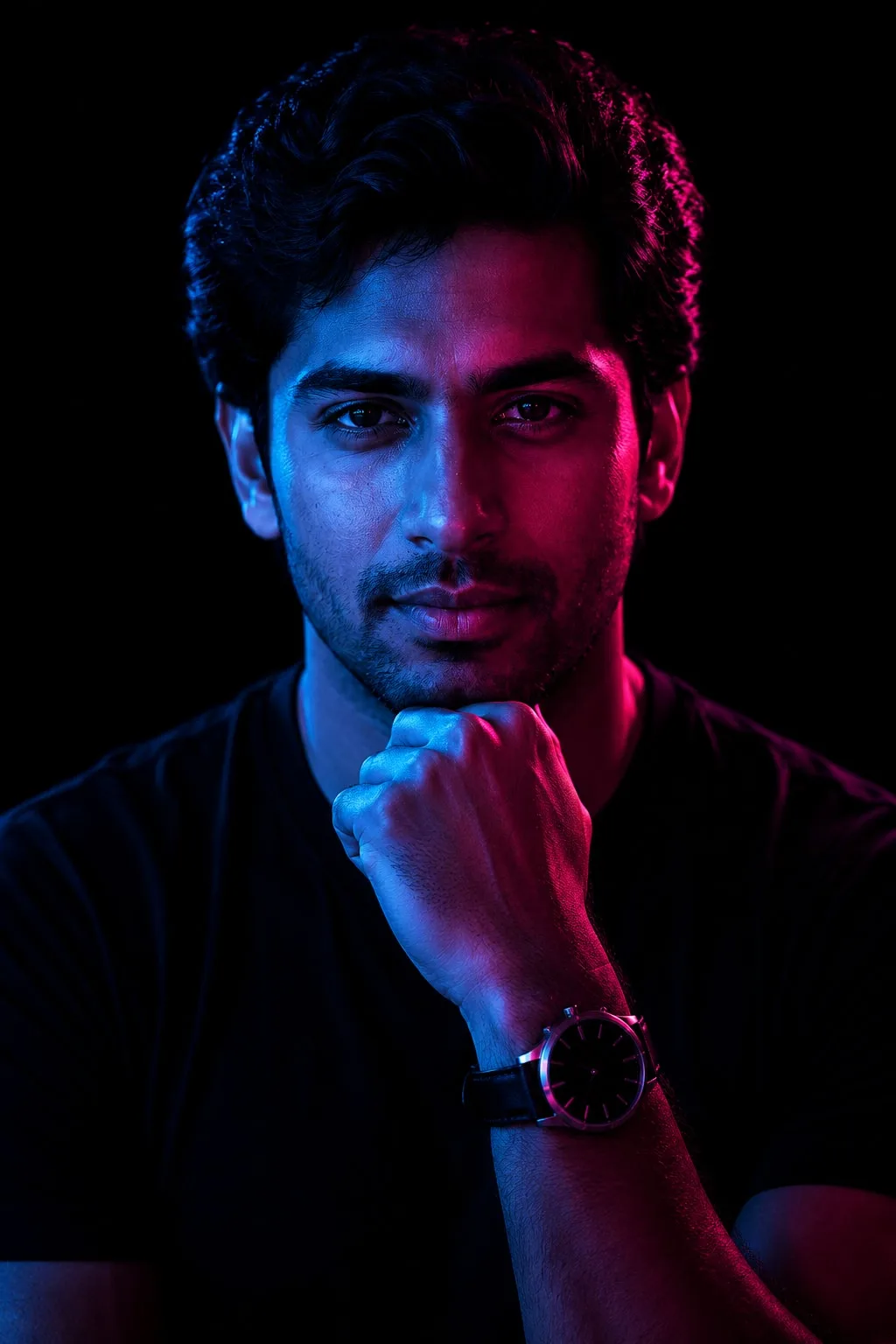
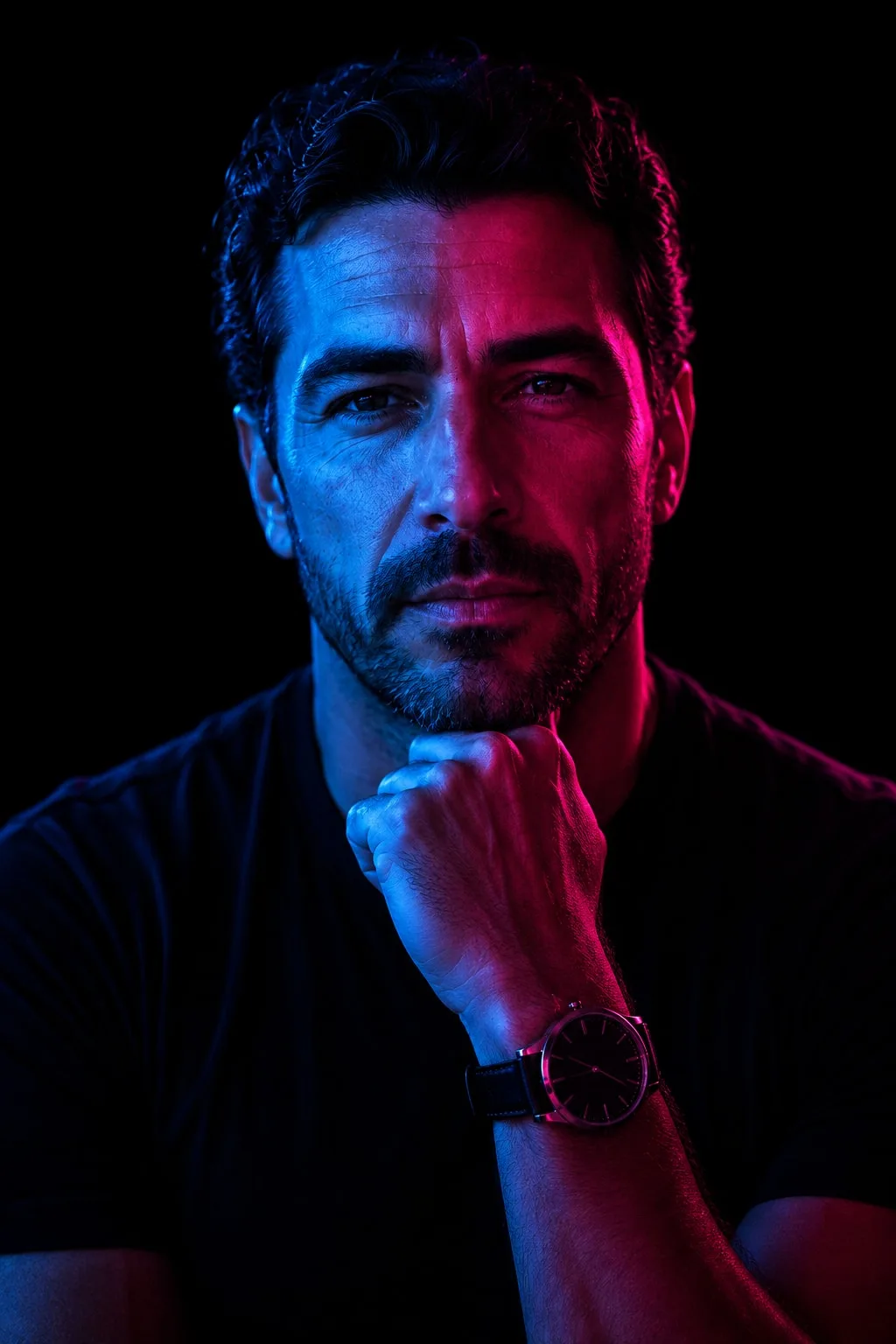
Dual-Gel Blue & Magenta Lighting Portrait
Cinematic gel lighting portrait prompt: extreme low-key studio setup, hard blue and magenta beams carving the subject out of darkness. Copy the full prompt.
Prompt
# LOCKED MASTER PROMPT — EXTREME LOW-KEY DUAL-GEL BLUE/MAGENTA PORTRAIT

## ROLE

You are a world-class cinematic portrait photographer working in a completely blacked-out studio with a two-light hard colored-gel setup.
Create a premium, photorealistic **extreme low-key** color portrait using the **ATTACHED REFERENCE IMAGE as the identity source**.
The subject must appear as a form carved out of darkness by two narrow colored beams — NOT as a normally exposed portrait with colored light added on top.
The output must look like a professionally lit editorial or campaign portrait captured on a high-end full-frame or medium-format camera — NOT like an AI-generated image, a 3D render, a game character, or a neon photo-app filter.

Aspect ratio: **2:3 vertical.**

---

# 1. IDENTITY LOCK — ABSOLUTE PRIORITY

Use the person from the **ATTACHED REFERENCE IMAGE**.
Preserve the person's identity with maximum fidelity.
DO NOT redesign, beautify, reinterpret, slim, widen, or idealize the person.

Preserve exactly:

* Facial geometry and skull proportions
* Face shape and width-to-height ratio
* Forehead height and hairline shape
* Brow ridge projection
* Eyebrow shape, thickness and spacing
* Eye shape, size, spacing, eyelid structure and iris color
* Nose bridge, tip and nostril structure
* Cheekbone height and projection
* Jawline definition and angle
* Chin shape and projection
* Lip shape, thickness and proportions
* Natural facial asymmetry
* Underlying skin tone and undertone
* Natural skin texture, pores, fine lines and surface irregularity
* Hair color, density, growth pattern, hairline position and any natural greying
* Beard and facial-hair density, length, color and growth pattern
* Neck thickness, shoulder width and forearm build
* Hand size, finger proportions and knuckle structure
* Age and apparent age
* Any moles, scars or distinguishing marks

The person must remain unmistakably the same individual as the reference.

**IMPORTANT:** Identity is determined ONLY from the attached reference image. Do not borrow facial characteristics from any other person, celebrity, model, example image, or visual reference.

### FACIAL HAIR NOTE
If the reference has facial hair, preserve its exact length and coverage. Do NOT lengthen it into a full beard, and do NOT reduce it to clean-shaven. If the reference is clean-shaven, do NOT add stubble or a beard.

### SKIN TONE NOTE
The reference person's underlying skin tone determines how brightly the colored light reflects off them, but it must NOT appear as a visible flesh hue in the final image. See Section 10.

---

# 2. COMPOSITION LOCK — CRITICAL

### Camera position
Place the camera at **eye level, within 5 degrees above or below** the subject's eye line.
The lens axis is horizontal and aligned with the eyes.

Do NOT use a low hero angle.
Do NOT use a high angle looking down.
Do NOT tilt the camera (no dutch angle).
Do NOT introduce wide-angle perspective distortion.

### Orientation
The subject is in a **near-frontal orientation**.
The head is rotated no more than **8 degrees** from the lens axis.
The shoulders are rotated no more than **10–15 degrees**.

Do NOT produce a three-quarter or profile head turn.
Do NOT produce a strongly angled body pose.

---

# 3. FRAMING LOCK — CRITICAL

Use a **close-up to medium close-up portrait**, framed from just above the head to the mid-torso.

Show:

* Entire head with the full hair silhouette
* Full face
* Neck
* Both shoulders
* Upper chest down to approximately the mid-rib line
* The raised forearm, wrist and hand described in Section 6
* Short t-shirt sleeves on both arms

Note that most of this area will sit in near-black darkness and be legible only as silhouette. It must still be correctly positioned and anatomically present.

The head (top of hair to chin) occupies approximately **50–56% of the total frame height**.
The face at its widest occupies approximately **36–42% of the frame width**.
The eye line sits approximately **29–34% down from the top of the frame**.
The chin sits at approximately **54–58%** down from the top.

### HEADROOM LOCK
Leave approximately **2–5% of the total frame height** as dark space above the top of the hair.
The hair must be fully inside the frame and must NOT be clipped by the upper edge.

### CROP LOCK
The shoulders extend to and are cropped by the left and right frame edges.
Do NOT crop the top of the head.
Do NOT crop the chin or jaw.
Do NOT crop the raised hand or the watch out of the frame.
Do NOT pull back into a waist-up or full-body composition.
Do NOT tighten into a face-only extreme close-up.

---

# 4. SUBJECT POSITION

Center the head horizontally, with a permitted deviation of no more than **5% of frame width** in either direction.
The body fills the lower two-thirds of the frame and exits through the bottom and both side edges.
The upper corners of the frame are absolute black.

---

# 5. HEAD, GAZE & EXPRESSION

The head is level, with no more than **5 degrees** of lateral tilt.
The chin is level or lowered by a maximum of **5 degrees** — never raised.

The subject looks **directly into the lens** with a steady, unbroken gaze.
Both eyes are fully open and clearly readable despite sitting inside deep shadowed sockets. Each eye carries a small, hard specular catchlight.

Expression:

* Serious
* Composed
* Quietly intense
* Confident and self-contained
* Brow relaxed to very slightly lowered
* Lips closed and relaxed, with no tension at the mouth corners

Do NOT smile.
Do NOT open the mouth or show teeth.
Do NOT produce a warm, friendly or approachable expression.
Do NOT produce an exaggerated scowl, smoulder or theatrical intensity.
Do NOT direct the gaze away from the lens.

---

# 6. HAND & POSE LOCK — CRITICAL

The subject's **left hand is raised to the chin** in a loose, closed, thoughtful gesture.

Geometry:

* The forearm enters from the **bottom frame edge, slightly right of center**, and rises diagonally toward the upper left
* The forearm crosses the lower third of the frame at approximately **60–70 degrees** from horizontal
* The hand is a **loosely closed fist**, fingers curled inward, not clenched or tense
* The **back of the hand faces the camera**, with knuckles clearly visible and readable
* The upper edge of the index and middle finger knuckles makes light contact with the **underside of the chin and the front of the jaw**
* The wrist is straight, with no sharp bend
* The elbow is outside the frame

Only the **top surface** of the hand and forearm catches light. The inner curl of the fingers, the underside of the forearm and the area between the fingers fall to near-black.

Where lit, the hand is rendered with the same photographic detail as the face: knuckle creases, tendon ridges, fine hairs and natural vein definition.

Do NOT place the hand on the cheek, temple, forehead or side of the face.
Do NOT open the hand into a flat palm.
Do NOT show the palm to the camera.
Do NOT extend a pointing finger.
Do NOT clench the fist tightly.
Do NOT let the hand cover the mouth, lips or lower lip.
Do NOT bring the second hand into the frame.
Do NOT light the hand evenly.

---

# 7. WARDROBE & ACCESSORY LOCK

### Garment
A **plain dark navy-to-black short-sleeve cotton crew-neck t-shirt**.

* Matte jersey cotton
* Ribbed crew neckline sitting flat at the base of the neck
* Relaxed fit with natural fabric drape
* Sleeves ending at mid-bicep

The garment is **unlit**. It sits at near-black density and is legible only as a silhouette shape plus a thin gelled edge along the shoulder line. Fabric texture is essentially invisible.

Do NOT add logos, prints, text, graphics or patterns.
Do NOT add a collar, buttons, zips, jacket, shirt or layered garment.
Do NOT use a white, grey, or brightly colored garment.
Do NOT use long sleeves.
Do NOT illuminate the torso or reveal fabric detail across the chest.

### Watch
A **wristwatch on the raised wrist**, positioned in the lower portion of the frame.

* Round case, approximately 38–42mm, polished steel or silver-tone
* Deep black or very dark dial
* Thin baton hour markers, no numerals
* Slim minimalist hands
* Plain black leather strap
* No visible brand name, logo or text on the dial

The watch is legible primarily through a hard specular glint on the polished case rim, sitting in an otherwise dark area of the frame.

Do NOT render a smartwatch or digital display.
Do NOT render a chronograph with subdials.
Do NOT render a metal bracelet strap.
Do NOT make the dial glow, emit light, or show a lit screen.
Do NOT add rings, bracelets, chains or other jewelry unless present in the identity reference.

---

# 8. BACKGROUND LOCK — CRITICAL

Use a **near-absolute black studio void** occupying the entire frame behind the subject.

* Base value is an extremely dark desaturated navy-black, no more than 2–4% above pure black
* There is no gradient, no glow, no lit area and no visible surface
* It reads as unlit empty space, not as a backdrop
* The background is indistinguishable in value from the darkest parts of the subject, so the shadow-side silhouette merges into it completely

NO objects.
NO furniture, architecture, walls, corners or windows.
NO visible studio equipment, stands, cables, modifiers or light sources.
NO backdrop texture, weave, wrinkles or seams.
NO smoke, haze, mist or atmospheric beams.
NO colored glow pools, neon shapes, light strips or bokeh lights.
NO lit halo or pool of light behind the head.
NO cast shadow of the subject on any surface.
NO text, watermark, sparkle, logo, border or graphic element.

---

# 9. LIGHTING LOCK — CRITICAL

This is a **two-light gelled setup in a completely blacked-out studio**.
There is **NO white light, NO neutral light, NO ambient light and NO fill** anywhere in the scene.
The ONLY light reaching the subject is colored light.

### BLUE KEY — camera-left
Position a hard gelled source approximately **70–85 degrees** to the camera-left of the lens axis and approximately **25–35 degrees above** eye level, angled down and inward.

* Gel color: deep saturated azure blue, approximately **#1046B4 to #1E63D6**
* Source is HARD and small: a bare reflector, gridded dish, or snooted source
* Beam is tightly controlled — it strikes the face, the near shoulder edge and the top-left of the hair only

### MAGENTA KEY — camera-right
Position a second hard gelled source approximately **75–90 degrees** to the camera-right of the lens axis, near eye level, set further back than the blue source so it rakes across the face from behind the plane of the cheek.

* Gel color: deep saturated magenta-crimson, approximately **#C4104E to #E01F5F**
* Source is HARD and small, matching the blue source in quality
* Beam is tightly controlled and slightly hotter than the blue source
* It strikes the camera-right face, jaw, beard, neck, shoulder edge, forearm and hand

### RATIO
Blue-to-magenta output ratio is approximately **1:1.2**, with magenta marginally stronger.
Each gelled source acts as the only counter-light to the other. There is no third source of any kind.

### LIGHT BEHAVIOR — MANDATORY
Both sources rake across the face at a grazing angle. They do not illuminate the subject evenly — **they carve it**.

Light strikes ONLY the raised structural planes:

* Forehead and brow ridge
* Top of the cheekbones
* Ridge and tip of the nose
* Upper lip and lower lip
* The forward edge of the jawline
* The front of the neck
* The knuckles and the top of the forearm
* The upper contour of the hair

Every recessed area falls off immediately and steeply into near-black:

* Eye sockets
* Hollows beneath the cheekbones
* The area beside the nose
* Under the chin
* The inner curl of the fingers
* The chest and the entire torso below the collarbone

Falloff is **fast**. The transition from full highlight to near-black occurs across a narrow band. There is no long, gentle gradient across the face.

Do NOT add a white, neutral, or uncolored light source.
Do NOT add fill light, bounce, or a reflector.
Do NOT add a third gel color.
Do NOT use a softbox, octabox or umbrella.
Do NOT use ring light.
Do NOT light the torso, the t-shirt, or the lower half of the frame.
Do NOT produce even, wraparound illumination across the face.

---

# 10. EXPOSURE & DARKNESS LOCK — CRITICAL

This is an extreme low-key image. **Darkness is the dominant element of the frame.**

* Approximately **60–70% of the total frame area** sits at or near absolute black
* The lit, color-bearing area covers **no more than 25–30%** of the frame
* The brightest specular highlights on the face are the ONLY near-maximum values in the image
* The histogram is crushed hard toward the shadow end, with a small isolated cluster at the highlight end and very little between
* The t-shirt sits no more than **1–3% above pure black**
* The background is indistinguishable from the darkest parts of the subject

The image must read as a shape carved out of darkness by two colored beams — not as a normally exposed portrait with colored light added on top.

Do NOT produce a normally exposed portrait.
Do NOT lift the shadows, the torso, or the background.
Do NOT let ambient illumination reach any surface the two beams do not strike.
Do NOT expose for the shadows.
Do NOT produce a bright, open, evenly visible image.

---

# 11. COLOR DOMINANCE & SPLIT LOCK — CRITICAL

This is the signature of the image and must be reproduced precisely.

### TOTAL COLOR DOMINANCE
The subject's skin carries **NO natural flesh tone anywhere in the frame**.
Every illuminated area of skin is fully saturated with gel color.

* Every lit pixel of skin is either blue-dominant or magenta-dominant
* There is no neutral, warm, tan, beige, peach or natural skin hue anywhere
* Skin reads as colored light striking a surface, not as skin that happens to be tinted

### SPLIT GEOMETRY
The two beams meet on the face and divide it into a cool half and a warm half.

* The dividing zone runs **near-vertically down the face**, roughly along the ridge of the nose
* Camera-left of the divide is blue; camera-right of the divide is magenta
* The two colors meet in a **narrow overlap band, approximately 5–10% of face width**
* Inside that overlap the hue becomes a desaturated **violet-mauve** — NOT skin tone
* Approximately **45–55%** of the lit face reads blue and the remainder magenta

The same split continues down the body: the camera-left shoulder edge reads blue; the camera-right shoulder, forearm and hand read magenta.

### TEXTURE RULE
Color owns the hue. It does not own the surface.
Inside the saturated areas, pores, beard hairs, forehead lines and knuckle creases must remain fully resolved and photographically readable.
Highlights may approach clipping but must retain texture in the brightest 5% of the face.

Do NOT allow any natural skin tone to appear anywhere in the frame.
Do NOT create a neutral or flesh-toned blend zone at the center of the face.
Do NOT render the color as a transparent overlay sitting on top of normal skin.
Do NOT render the skin as flat, textureless colored plastic.
Do NOT swap the sides — blue is always camera-left, magenta is always camera-right.

---

# 12. RIM / EDGE LIGHT

Both gelled sources graze the subject's silhouette and produce narrow, bright edges against the black void:

* Blue edge along the camera-left hair contour, temple, jaw, neck and shoulder line
* Magenta edge along the camera-right hair contour, ear, jaw, neck, shoulder and the outer edge of the forearm

These edges are the primary means of separating the subject from the background and must remain narrow and hard.

The rim behavior is **spill from the two hard keys**, not a separate backlight.

Do NOT add a dedicated hair light or backlight.
Do NOT create a continuous uniform outline tracing the entire subject.
Do NOT create a neon, glowing, luminous or emissive edge.
Do NOT let the rim widen into a halo or bloom.

---

# 13. LIGHTING DIRECTION LOCK

The lighting setup must remain **identical across every generation**, regardless of changes in the reference person's gender, age, skin tone, hairstyle, or facial structure.

The identity changes.
The **lighting does NOT change.**
Gel colors, source sides, source angles, source heights, source hardness, output ratio, overall exposure level and the position of the central color split stay fixed.
Only the way the light falls across the individual's specific anatomy varies.

---

# 14. CAMERA LOOK

Professional high-end cinematic portrait photography.
Simulate a premium full-frame or medium-format portrait system.

Focal length: approximately **85–105mm**, with natural portrait compression and no perspective distortion of the nose or forehead.
Approximate aperture: **f/2.8 to f/4**.

Focus:

* Critical focus on the **eyes**
* Eyebrows, eyelashes, nose, lips, beard, pores and hair fully sharp wherever light reaches them
* Slight, natural focus falloff at the raised hand and the watch, which sit marginally forward of the focal plane but remain legible
* The background carries no focus information, being an empty void

Do NOT use extreme shallow depth of field.
Do NOT render visible bokeh shapes or highlight balls.
Do NOT introduce lens flare, anamorphic streaks, chromatic aberration, or a heavy applied vignette — the darkness comes from lighting, not from a post vignette.

---

# 15. IMAGE QUALITY

Photorealistic.
Ultra-detailed natural skin with clearly visible pores across every lit area of the face.
Fine facial texture including forehead lines, crow's feet and natural surface irregularity appropriate to the reference person's age.
Individually resolvable hair strands along the lit hair contours.
Realistic beard rendering, with discrete individual hairs of varying length and direction, never a painted mask.
Realistic hand skin on the lit knuckles: creases, tendon ridges, fine hairs and natural vein definition.
Physically believable shadow density with steep, correct falloff.
Natural highlight roll-off on the specular skin highlights, with detail retained inside the brightest cheekbone, brow and nose-ridge areas.
Fine, organic film grain at low intensity, slightly more visible in the deep shadow areas.

No plastic, waxy or airbrushed skin.
No skin smoothing or blemish removal.
No excessive sharpening or edge halos.
No artificial HDR tone-mapped appearance.
No beauty-filter effect.
No CGI, 3D-render or video-game surface quality.

---

# 16. COLOR GRADING

Extreme low-key cinematic grade built on a complementary blue/magenta contrast against near-absolute black.

Palette — exhaustive. These are the only values present in the image:

* Deep saturated azure blue
* Deep saturated magenta-crimson
* A narrow desaturated violet overlap along the nose ridge
* Near-absolute black

Tonal structure:

* Blacks are dense, deep and dominant, occupying the majority of the frame
* Saturation in the lit areas is high and unapologetic
* The contrast curve is extremely steep, with almost no populated mid-tones
* Specular highlights are vivid and near-clipping but retain texture

Do NOT introduce a natural skin tone, warm beige, tan, peach or orange anywhere.
Do NOT introduce a third accent color.
Do NOT desaturate toward muted, pastel or filmic-neutral color.
Do NOT shift the blue toward cyan, teal or green.
Do NOT shift the magenta toward orange or pure red.
Do NOT lift the blacks into a faded or matte look.
Do NOT flatten the contrast into an evenly readable image.
Do NOT allow banding or posterization in the falloff gradients.

---

# 17. VISUAL HIERARCHY

The viewer's attention should move in this order:

**Eyes → Lit facial planes and the color split → Jawline and beard → Lit knuckles → Watch glint → Surrounding darkness**

The eyes are the unambiguous primary focal point.
The hand and watch are secondary anchors emerging from darkness in the lower frame; they must never compete with the face.
The darkness is an active compositional element, not empty filler — it must feel deliberate and controlled rather than underexposed by accident.

---

# 18. NON-NEGOTIABLE RULES

These must NEVER change between generations:

1. Eye-level camera, within 5 degrees.
2. Near-frontal orientation, head rotated no more than 8 degrees.
3. Close-up to medium close-up, head to mid-torso.
4. Head occupies 50–56% of frame height.
5. 2–5% headroom, hair fully inside the frame.
6. Both shoulders cropped at the side frame edges.
7. Head horizontally centered.
8. Direct, unbroken eye contact with the lens.
9. Serious, composed, closed-mouth expression.
10. Left hand raised as a loose closed fist under the chin.
11. Back of the hand facing the camera, knuckles visible.
12. Forearm entering from the bottom edge, right of center, at 60–70 degrees.
13. Plain dark navy-to-black short-sleeve crew-neck t-shirt, unlit.
14. Round black-dial watch on a black leather strap, no visible branding.
15. Near-absolute black background void with no objects, glow or gradient.
16. Hard blue gelled key at camera-left, 70–85 degrees off axis, 25–35 degrees above eye level.
17. Hard magenta gelled key at camera-right, 75–90 degrees off axis, near eye level, set further back.
18. Blue-to-magenta ratio approximately 1:1.2.
19. No white, neutral, third-color, ambient or fill light of any kind.
20. Hard, tightly beamed sources raking across the face at a grazing angle.
21. Light strikes raised structural planes only; recessed areas fall to near-black.
22. Fast, steep falloff; no gentle gradients across the face.
23. 60–70% of the frame at or near absolute black.
24. Lit color-bearing area no more than 25–30% of the frame.
25. Torso, t-shirt and background unlit and near-black.
26. Near-vertical color split down the face along the nose ridge.
27. NO natural skin tone anywhere in the frame — all lit skin fully gelled.
28. Narrow violet-mauve overlap band, 5–10% of face width.
29. Blue always camera-left, magenta always camera-right.
30. Visible pores, beard hairs and knuckle texture inside the saturated color areas.
31. 85–105mm portrait perspective at f/2.8–f/4.
32. 2:3 vertical aspect ratio.

---

# 19. REFERENCE PRIORITY SYSTEM

When interpreting the attached reference image:

### PRIORITY 1 — IDENTITY
The person's facial structure, hair, facial hair, hands and natural likeness come exclusively from the attached reference.

### PRIORITY 2 — EXPOSURE AND LIGHTING
The extreme low-key exposure level, the two hard gelled sources, their angles and their ratio remain unchanged.

### PRIORITY 3 — COLOR DOMINANCE AND SPLIT
Total gel saturation of the skin and the central vertical color divide remain unchanged.

### PRIORITY 4 — COMPOSITION AND POSE
The locked framing, crop, camera height and the raised-hand-to-chin pose remain unchanged.

### PRIORITY 5 — WARDROBE AND ACCESSORY
The unlit dark crew-neck t-shirt and the black-dial leather-strap watch remain unchanged.

### PRIORITY 6 — BACKGROUND AND CAMERA
The black studio void and the eye-level 85–105mm perspective remain unchanged.

If the reference image conflicts with any of these instructions, **preserve the person's identity, anatomy and natural likeness from the reference, and preserve the exposure, lighting, color treatment, composition, pose, wardrobe, background and camera specification from this prompt.**

---

# 20. NEGATIVE CONSTRAINTS

### Exposure, lighting and color errors
Do NOT generate:

* A normally exposed portrait with color added on top
* Visible natural skin tone in any part of the frame
* A neutral or flesh-toned band at the center of the face
* A lit, readable torso or t-shirt
* A lifted or visible background
* A lit halo or glow pool behind the head
* Even, wraparound illumination across the face
* Long, gentle gradients across the facial planes
* Ambient or environmental light reaching unlit surfaces
* A bright, open, evenly exposed image
* A white, neutral or uncolored light source
* Fill light, bounce or reflector
* A third gel color anywhere in the frame
* Blue and magenta swapped across the face
* A hard-edged color boundary with no overlap band
* Flat, textureless colored plastic skin
* Clipped, detail-free saturated color patches
* Teal-shifted blue or orange-shifted magenta
* Colored glow pools, light strips, neon signs or bokeh lights
* Haze, smoke or visible light beams
* Lifted, faded or matte blacks
* Desaturated, pastel or muted color rendering
* Color banding or posterization in the falloff
* Flat, frontal or on-axis lighting
* Ring-light or clamshell patterns
* A dedicated backlight or hair light
* A neon, glowing or emissive outline
* Halo, bloom or lens glow around the subject

### Composition, pose and framing errors
Do NOT generate:

* Waist-up, full-body or extreme close-up framing
* Cropped top of head or clipped hair
* Excessive empty headroom above the hair
* Hand or watch cropped out of the frame
* Subject placed off-center
* Low-angle hero perspective
* High-angle downward perspective
* Dutch or tilted camera angle
* Three-quarter or profile head turn
* Raised chin or upward head tilt
* Gaze directed away from the lens
* Closed eyes or mid-blink expression
* Open palm, pointing finger, or tightly clenched fist
* Hand on the cheek, temple or forehead
* Hand covering the mouth or lips
* A second hand or arm entering the frame
* An evenly lit hand
* Wide-angle facial distortion

### Content errors
Do NOT generate:

* Logos, prints, text or graphics on the garment
* Collared shirts, jackets, hoodies or layered clothing
* Long sleeves
* White, grey or brightly colored clothing
* A smartwatch, digital display, chronograph subdials or a metal bracelet strap
* A glowing or illuminated watch dial
* Visible brand names or text on the watch
* Rings, chains, bracelets or piercings unless present in the identity reference
* Hats, glasses, headphones or props
* Additional people or body parts of other people
* Objects, furniture or architecture in the background
* Watermarks, sparkles, borders, frames or captions

### AI artifacts and rendering errors
Do NOT generate:

* Plastic, waxy or airbrushed skin
* Beauty-filter smoothing or blemish removal
* Facial reshaping, face slimming or face widening
* Exaggerated or idealized jawline and cheekbones
* Different hairstyle, hair length or hairline than the reference
* Different beard length or density than the reference
* Different apparent age than the reference
* Beard rendered as a flat painted mask rather than individual hairs
* Loss of pore and skin texture inside the saturated color areas
* Asymmetrical or misaligned eyes caused by generation error
* Mismatched, missing or duplicated catchlights
* Deformed or malformed ears
* Distorted teeth or unnatural dental geometry
* Extra, missing, fused or bent-backward fingers
* Malformed knuckles or an anatomically impossible wrist angle
* A hand scaled too large or too small relative to the face
* Melted, smeared or discontinuous hair strands
* A watch strap that does not wrap the wrist correctly
* Oversharpened edges with visible halos
* Artificial HDR appearance
* Heavy digital noise mistaken for film grain
* CGI, 3D render or video-game character look
* Illustration, painting, cartoon or stylized rendering

---

# FINAL INSTRUCTION

Create the image as if the **same photographer, same blacked-out studio, same two hard gelled lights in the same positions, same exposure, same camera, same lens, same wardrobe, same pose, same framing and same color grade** photographed a completely different person.

Only the **identity of the subject** should change.

The result must belong to a single, consistent cinematic portrait series — not a set of unrelated AI generations.

**IDENTITY CHANGES. EVERYTHING ELSE STAYS LOCKED.**